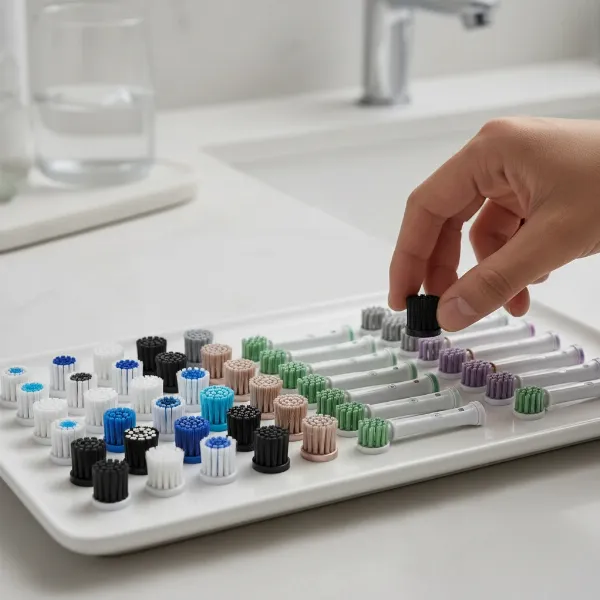
Are you intrigued by the viral sensation of U-shaped electric toothbrushes, promising a perfect clean in mere seconds? The idea of a hands-free device that meticulously cleans all your teeth simultaneously is certainly appealing, especially for busy individuals or parents looking for an easy solution for their children. However, as an expert with over a decade in electric toothbrush technology, I’ve seen countless innovations come and go. This article will cut through the marketing noise to deliver an honest, evidence-based answer: do U-shaped electric toothbrushes truly work for optimal oral hygiene? We’ll explore their design, popularity, and most importantly, the scientific and expert consensus on their effectiveness, guiding you toward proven methods for a healthy smile.
What Are U-Shaped Electric Toothbrushes?
U-shaped electric toothbrushes represent a distinct category in oral care, designed with a mouthpiece that wraps around both the upper and lower dental arches simultaneously. Often marketed as “automatic” or “hands-free” brushes, they aim to simplify the brushing process, often featuring soft silicone bristles and vibrating or sonic technology. The core principle behind their design is to offer a comprehensive clean across all tooth surfaces at once, significantly reducing brushing time to as little as 30-60 seconds. This innovative approach seeks to provide convenience and efficiency, diverging from the traditional method of brushing individual tooth surfaces.
The Allure: Why Are They Popular?
The widespread appeal of U-shaped electric toothbrushes largely stems from their promise of speed and convenience, a potent combination in our fast-paced world. Social media platforms have amplified their visibility, with numerous videos showcasing their “hands-free” operation and quick cleaning cycles. For parents, they often appear as a “hack” to encourage children, especially reluctant brushers, to maintain some form of oral hygiene. The marketing often highlights minimal effort for maximum results, making them an attractive alternative to the more manual and time-consuming traditional brushing methods. This perception of effortless efficiency has driven their popularity, creating a significant buzz in the oral care market.
Do U-Shaped Electric Toothbrushes Really Work? The Scientific Verdict
Despite their appealing promises, the scientific evidence regarding the effectiveness of U-shaped electric toothbrushes in removing dental plaque is largely unfavorable. A pivotal randomized controlled trial published in the International Journal of Environmental Research and Public Health concluded that the U-shaped automatic electric toothbrush tested was “not effective in removing dental plaque.” Remarkably, its efficacy was found to be statistically similar to “no brushing” at all.
This significant finding highlights a critical flaw in their design and functionality. The primary issue is the inadequate contact of the bristles with all tooth surfaces, particularly along the gumline and in the crucial interdental spaces where plaque often accumulates. The fixed shape and size of the U-shaped mouthpiece mean it cannot conform effectively to the unique dental arch of every individual. As a result, many areas of the teeth and gums are simply not cleaned, leading to persistent plaque buildup. While some manufacturers claim their U-shaped brushes remove more plaque, independent scientific studies have consistently painted a different picture, emphasizing their limitations compared to proven brushing techniques.
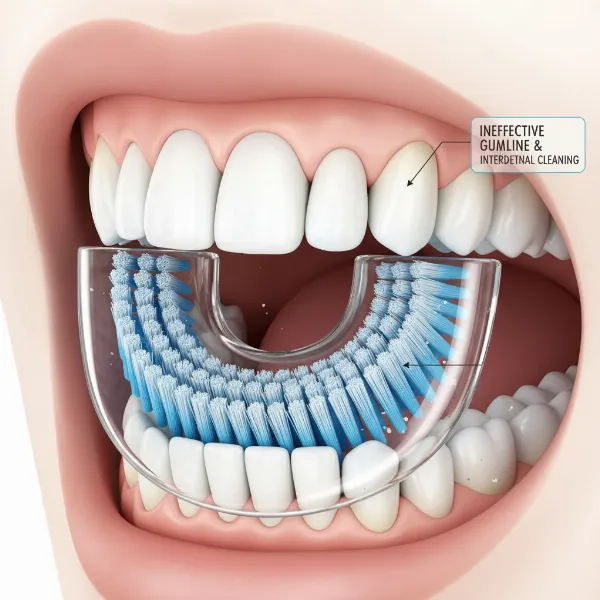 A U-shaped electric toothbrush failing to reach all tooth surfaces, illustrating poor contact for plaque removal.
Expert Opinions: What Dentists Say
Dental professionals across the board express significant concerns about the routine use of U-shaped electric toothbrushes. Orthodontists and general dentists alike consider them “far inferior compared to traditional toothbrushes” and generally advise against their use for daily oral hygiene. Many dentists, like Dr. Sandip Sachar, a general and cosmetic dentist, report seeing “increased plaque buildup along the gumline, and some even had cavities at a very young age” in patients who switched to these devices.
The consensus among experts is that these devices do not adequately reach all tooth surfaces to effectively remove plaque, food particles, and bacteria. This can lead to serious oral health issues such as tooth decay, gum inflammation (gingivitis), and persistent bad breath. The fundamental requirement for effective brushing is for bristles to reach under the gumline at a 45-degree angle, a task that U-shaped brushes with their fixed design struggle to accomplish. Dr. Shaun Dadjoo, a board-certified orthodontist, states unequivocally, “There is no age, stage, or group where a U-shaped brush would be recommended.” This underscores the professional community’s strong reservation about their role in maintaining optimal oral health.
“U-shaped toothbrushes are just not effective enough. Without exception, children who used them had increased plaque buildup along the gumline, and some even had cavities at a very young age.” – Dr. Sandip Sachar, General and Cosmetic Dentist
Understanding the Different Types of Electric Toothbrushes
When considering electric toothbrushes, it’s crucial to understand the distinct technologies available. This allows for an informed choice that prioritizes effective plaque removal and gum health.
Conventional Electric Toothbrushes
These are the most widely recommended and scientifically proven types of electric toothbrushes:
- Oscillating/Rotating Electric Toothbrushes: These brushes feature small, round brush heads that rapidly oscillate (vibrate side-to-side) and rotate in a circular motion. This action, often combined with pulsating movements, effectively breaks up and sweeps away plaque from each tooth surface. Brands like Oral-B are well-known for this technology.
- Advantages: Excellent plaque removal, often equipped with pressure sensors to prevent over-brushing, widely available, and generally affordable.
- Disadvantages: Can feel more aggressive due to stronger vibrations, brush head size might be challenging for some areas.
- Sonic Electric Toothbrushes: These brushes use high-frequency vibrations, generating up to 30,000-60,000 brush strokes per minute. The rapid vibrations create fluid dynamics that reach beyond the bristle tips, cleaning not only the tooth surface but also dislodging plaque from areas slightly beyond direct contact, such as between teeth and along the gumline. Philips Sonicare is a prominent brand in this category.
- Advantages: Gentle yet highly effective cleaning, longer brush heads similar to manual brushes can be intuitive, fluid dynamics aid in cleaning beyond direct contact.
- Disadvantages: Can be more expensive than oscillating-rotating models, some users might find the high-frequency vibration ticklish initially.
|
Our Picks for the Best Electric Toothbrush in 2026
As an Amazon Associate I earn from qualifying purchases.
|
||
| Num | Product | Action |
|---|---|---|
| 1 | Oral-B Pro 1000 Rechargeable Electric Toothbrush, Black |

|
| 2 | Philips Sonicare 4100 Rechargeable Electric Toothbrush, Advanced Plaque Removal, Pressure Sensor, Includes Brush Head Case, White BD5002AZ |
|
| 3 | Philips Sonicare 1100 Series Electric Toothbrush - Sonic Toothbrush with Advanced Sonic Technology, EasyStart, Smartimer & Quadpacer, White, Model HX3641/02 |
|
| 4 | Oral-B Pro 1000 Rechargeable Electric Toothbrush, White |
|
| 5 | Oral-B iO Simple Clean Rechargeable Electric Powered Toothbrush, Night Black with 1 Gentle Care Brush Head and 1 Black Travel Case - Automatic Pressure Sensor to Protect Gums - 3 Modes - 2 Min Timer |
|
| 6 | Oral-B iO Simple Clean Rechargeable Electric Powered Toothbrush, Pure White with 1 Gentle Care Brush Head and 1 White Travel Case - Automatic Pressure Sensor to Protect Gums - 3 Modes -2 Min Timer |
|
| 7 | COSLUS Sonic Electric Toothbrush for Adults C40(DY-108Pro): 47000 VPM for Deep Cleaning with Travel Case - 5 Modes for Sensitive Teeth & Brace, Wireless Charging, 6 Brush Heads for Family, Black (1PC) |
|
| 8 | Philips Sonicare 4100 Series Electric Toothbrush - Sonic Toothbrush with Advanced Sonic Technology, Pressure Sensor, Two Intensity Settings, Smartimer & Quadpacer, Deep Pink, Model HX3681/26 |
|
| 9 | Onlyone Sonic Electric Toothbrush for Adults, Rechargeable Ultrasonic Electric Toothbrush with 8 Brush Heads, Travel Case, Charging Base & Wireless Charging - 5 Modes with Smart Timer |
|
| 10 | Philips Sonicare 2100 Series Electric Toothbrush - Sonic Toothbrush with Advanced Sonic Technology, Two Intensity Settings, Smartimer & Quadpacer, White, Model HX3661/04 |
|
U-Shaped Electric Toothbrushes
In contrast to conventional electric toothbrushes, U-shaped brushes operate on a fundamentally different principle, aiming for simultaneous cleaning of all teeth.
- U-shaped Electric Toothbrushes: These devices consist of a flexible, U-shaped mouthpiece lined with bristles (often silicone) that users bite into. They vibrate or pulse to theoretically clean all tooth surfaces at once.
- Advantages (as marketed): Claimed time-saving, ease of use (especially for children or those with limited dexterity), covers entire arches.
- Disadvantages (as proven): Poor plaque removal efficacy, inability to reach gumline and interdental spaces, inconsistent fit for individual mouth shapes, not recommended by dental professionals for routine hygiene.
Comparison of Electric Toothbrush Types
| Feature | Oscillating/Rotating Electric | Sonic Electric | U-Shaped Electric Toothbrush |
|---|---|---|---|
| Plaque Removal | Excellent | Excellent | Poor / Ineffective |
| Gumline Access | Very good | Very good | Very Poor |
| Interdental Clean | Good | Very good (fluid dynamics) | Very Poor |
| Motion | Oscillates, rotates, pulsates | High-frequency vibrations | Vibrations/pulsations |
| Bristle Material | Nylon | Nylon | Often Silicone |
| Fit | Adapts to individual teeth | Adapts to individual teeth | Fixed, often ill-fitting |
| Dental Consensus | Highly Recommended | Highly Recommended | Not Recommended for routine use |
Benefits of Proven Electric Toothbrushes
Opting for a conventional electric toothbrush—either an oscillating/rotating or a sonic model—offers a multitude of scientifically backed benefits that significantly outperform both manual brushes and the claims of U-shaped devices.
- Superior Plaque Removal: Studies consistently show that conventional electric toothbrushes remove significantly more plaque than manual toothbrushes, particularly along the gumline and in hard-to-reach areas. Their advanced motions efficiently disrupt and sweep away bacterial biofilm.
- Improved Gum Health: By effectively removing plaque and reducing gingivitis, these brushes contribute to healthier gums. Many models also feature pressure sensors to prevent users from brushing too hard, which can protect delicate gum tissue from recession.
- Enhanced Cleaning Consistency: Electric toothbrushes take the guesswork out of brushing. Built-in timers ensure you brush for the dentist-recommended two minutes, often with quadrant timers that prompt you to move to different sections of your mouth.
- Support for Whitening: More effective plaque and stain removal can naturally lead to brighter teeth over time, helping to prevent surface stains from forming.
- User-Friendly Features: Many models come with smart features like Bluetooth connectivity to track brushing habits, multiple cleaning modes (e.g., sensitive, whitening, gum care), and long-lasting batteries, making the brushing experience both effective and convenient.
- Ideal for Diverse Needs: For individuals with limited dexterity, braces, or other specific oral health concerns, the consistent and powerful action of a conventional electric toothbrush can be particularly beneficial, compensating for manual limitations.
How to Choose an Effective Electric Toothbrush
Selecting the right electric toothbrush is a personal decision that impacts your daily oral hygiene. Here’s a guide to help you choose a model that truly delivers on its promise of a healthy smile:
- Consider Your Budget: Electric toothbrushes vary widely in price. While premium models offer advanced features, excellent entry-level and mid-range options provide superb cleaning performance without breaking the bank. Focus on core effectiveness over excessive bells and whistles if budget is a primary concern.
- Understand Brush Head Technology: Decide between an oscillating/rotating brush (like Oral-B) for targeted cleaning of each tooth, or a sonic brush (like Philips Sonicare) for a broader cleaning action that creates fluid dynamics. Both are highly effective, and preference often comes down to personal feel.
- Look for Essential Features:
- 2-Minute Timer with 30-Second Quadrant Pacer: This ensures you brush for the recommended duration and evenly clean all areas of your mouth.
- Pressure Sensor: A crucial feature that alerts you if you’re brushing too hard, protecting your gums and enamel from damage.
- Multiple Cleaning Modes (Optional but beneficial): Modes like “sensitive,” “whitening,” or “gum care” can cater to specific needs.
- Long Battery Life & Charging Options: Consider how often you want to charge and if features like USB charging or a travel case are important.
- Choose the Right Brush Head: Electric toothbrushes come with various brush heads designed for different purposes (e.g., sensitive, deep clean, whitening). Ensure you select a soft-bristled head appropriate for your oral health needs.
- Prioritize Reputable Brands: Stick with established brands like Philips Sonicare and Oral-B, which have a long history of research, development, and dental professional recommendations.
- Read Reviews and Seek Dental Advice: Always check independent reviews from trusted sources and, ideally, consult with your dentist or hygienist. They can offer personalized recommendations based on your specific oral health profile.
Top Recommended Electric Toothbrushes
While U-shaped electric toothbrushes fall short, several conventional electric toothbrushes consistently earn high marks for their superior plaque removal and innovative features. Here are a few top-rated options that dental professionals often recommend for maintaining excellent oral hygiene:
- Philips Sonicare 9900 Prestige: This premium sonic toothbrush features AI-powered brushing guidance and automatic intensity adjustment, offering an exceptionally thorough and gentle clean. Its sleek design and smart technology make it a top choice for those seeking advanced oral care.
- Oral-B iO Series 9 (and higher): Combining oscillating-rotating technology with micro-vibrations, the iO Series offers a remarkably quiet and effective cleaning experience. Features like a color display, multiple smart modes, and AI tracking provide real-time feedback for improved brushing technique.
- Philips Sonicare 4100 Rechargeable Electric Toothbrush: An excellent value option, the Sonicare 4100 provides essential features like a pressure sensor and a 2-minute timer. It offers the powerful sonic cleaning that Philips is known for, without the premium price tag.
- Oral-B Pro 1000: Often recommended for its competitive price and robust cleaning power, the Oral-B Pro 1000 is an ADA-accepted toothbrush. It features an oscillating head and a built-in timer, making it a reliable choice for effective daily brushing.
- Suri 2.0 Sustainable Electric Toothbrush: For the eco-conscious, the Suri 2.0 stands out with its plant-based replacement heads, aluminum body, and UV-C cleaning case. It offers strong sonic performance while addressing environmental concerns.
These models, representing both sonic and oscillating-rotating technologies, are widely recognized for their ability to deliver a dentist-clean feeling and significantly contribute to long-term oral health.
How to Use an Electric Toothbrush Correctly
Using an electric toothbrush effectively is crucial for maximizing its benefits. Even the best brush needs proper technique.
- Charge Your Brush: Ensure your electric toothbrush is fully charged according to the manufacturer’s instructions.
- Apply Toothpaste: Apply a pea-sized amount of fluoride toothpaste to the brush head.
- Position the Brush: Place the brush head against your teeth at a slight angle, pointing the bristles towards your gumline. Unlike manual brushing, you don’t need to scrub.
- Glide, Don’t Scrub: Gently guide the brush head slowly from tooth to tooth, allowing the electric motions to do the work. Hold the brush on each tooth for a few seconds.
- Clean All Surfaces: Ensure you clean all surfaces of each tooth: the outer surfaces, the inner surfaces, and the chewing surfaces.
- Follow the Timer: Most electric toothbrushes have a built-in 2-minute timer, often with a 30-second pacer for each quadrant of your mouth. Pay attention to these alerts to ensure even cleaning.
- Address the Gumline: Gently let the bristles reach the gumline without pressing too hard. If your brush has a pressure sensor, it will alert you if you’re applying too much force.
- Rinse and Clean: After brushing, rinse your mouth and the brush head thoroughly under running water. Store your brush upright to air dry.
- Replace Brush Heads: Replace your electric toothbrush head every three months, or sooner if the bristles appear splayed or worn, to maintain optimal cleaning performance and hygiene.
When Might a U-Shaped Toothbrush Be Considered?
While general dental professionals do not recommend U-shaped electric toothbrushes for routine oral hygiene due to their proven ineffectiveness in plaque removal, there are very rare and specific circumstances where they might be considered, though always as a last resort and under professional guidance.
For individuals with severe physical or cognitive disabilities, or those recovering from injuries that profoundly limit their ability to use a conventional toothbrush (manual or electric), a U-shaped device might offer a minimal level of oral cleaning where no other method is feasible. In such extremely challenging situations, a U-shaped toothbrush could be “better than no toothbrush at all,” as acknowledged by some experts. However, it’s critical to understand that even in these cases, it would not provide optimal cleaning and should be supplemented by other oral care measures if possible, and always discussed with a dental professional to manage expectations and mitigate potential risks like plaque accumulation and subsequent dental problems. These are not tools for general public use or for those simply seeking a quicker, easier brushing experience.
Conclusion
The pursuit of effortless oral hygiene is understandable, but when it comes to U-shaped electric toothbrushes, the scientific evidence and expert consensus are clear: they generally do not provide an effective clean for removing dental plaque. While marketed for convenience and speed, independent studies show their performance is often comparable to not brushing at all, primarily due to their inability to adequately reach all tooth surfaces, especially along the gumline.
For truly effective oral care, traditional electric toothbrushes—whether oscillating/rotating or sonic—remain the gold standard. These proven devices, combined with proper technique, a quality fluoride toothpaste, and regular dental check-ups, offer the comprehensive plaque removal and gum health benefits essential for a lifelong healthy smile. Don’t be swayed by viral trends that compromise your oral health. Prioritize efficacy, expert recommendations, and a consistent routine with a reliable electric toothbrush. What steps will you take today to ensure your brushing routine is truly effective?
Frequently Asked Questions
Are U-shaped electric toothbrushes approved by the American Dental Association (ADA)?
No, as of early 2026, U-shaped electric toothbrushes do not carry the American Dental Association (ADA) Seal of Acceptance. The ADA Seal signifies that a product has met rigorous scientific criteria for safety and effectiveness, and currently, U-shaped designs have not demonstrated adequate performance in plaque removal.
Can children use U-shaped electric toothbrushes effectively?
Dental experts generally advise against children using U-shaped electric toothbrushes as their primary method of cleaning. While they may seem like a fun “hack” to get kids to brush, studies indicate they do not effectively remove plaque, potentially leading to increased cavities and poor oral hygiene even for young users.
How do U-shaped electric toothbrushes compare to sonic toothbrushes?
U-shaped Electric Toothbrushes are significantly less effective than conventional sonic toothbrushes. Sonic toothbrushes use high-frequency vibrations to create fluid dynamics that clean teeth and along the gumline thoroughly, whereas U-shaped brushes often fail to make adequate contact with all tooth surfaces, resulting in poor plaque removal.
What are the main drawbacks of using a U-shaped electric toothbrush?
The primary drawbacks include very poor plaque removal, inability to reach the gumline and between teeth effectively, a fixed design that doesn’t conform to all mouth shapes, and a high risk of developing dental issues like cavities and gum disease due to insufficient cleaning.
Are there any situations where a U-shaped toothbrush is recommended?
In extremely rare cases, for individuals with severe physical or cognitive disabilities that prevent them from using any conventional brushing method, a U-shaped toothbrush might be considered a last resort. However, even then, it offers minimal cleaning and does not substitute for proper oral hygiene.